

Bone Grafting
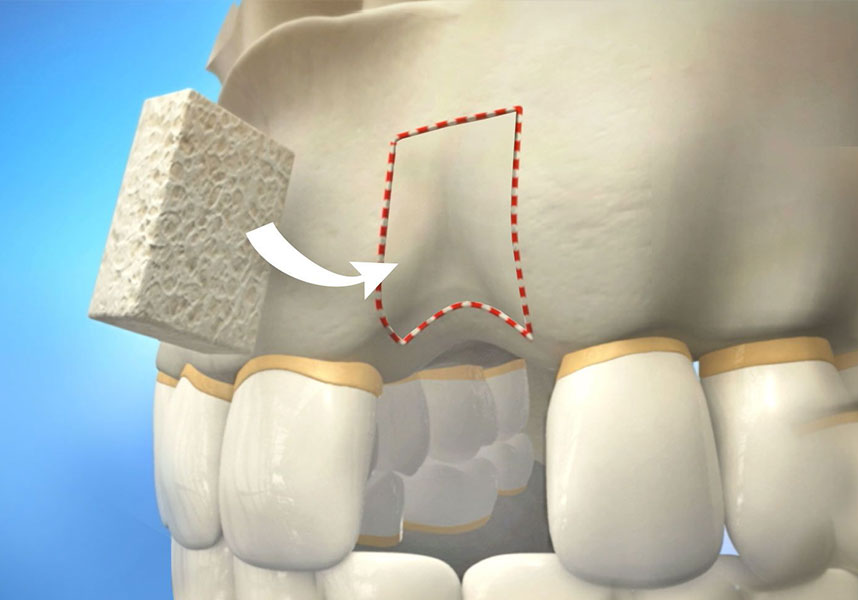
If we find your jawbone isn’t thick enough or is too soft, you may need bone grafting before you can have dental implant surgery. That’s because the chewing action of your mouth exerts great pressure on your bone, and if it can’t support the implant, the surgery will likely fail. A bone graft can create a more solid base for the implant.
There are several bone graft materials that can be used to rebuild a jawbone. Options may include a natural bone graft, such as from another location in your body, or a synthetic bone graft, such as bone-substitute material that can provide support structures for new bone growth.
We will go through all the options with you and find what works best for you.

It may take several months for the transplanted bone to grow enough new bone to support a dental implant. In some cases, you may need only minor bone grafting, which can be done at the same time as the implant surgery. The condition of your jawbone determines how you proceed.
Methods For Augmentation
Autogenic material Autogenous bone-building material (self-bone), is made of the own bone, which is taken somewhere else in the body. The bone typically comes from the chin, jaw, tibia, hip or skull. Autogenous bone augmentation material is advantageous because the material is living bone, meaning that it contains living cellular elements that enhance bone growth, and the danger of body-rejection is very low.
Allogenic material Allogenic bone or allograft is dead bone which is donated by patients undergoing hip joint replacement surgery, and is then processed using a freeze-drying method to extract the water through a vacuum. Unlike autogenous bone, allogenic bone itself can not produce new bone. Rather, it serves as a scaffolding that allows bone to grow from the surrounding bone walls to fill the defect or void.
Xenogenic material Xenogenic bone comes from non-living bone of another species, usually a cow. The bone is processed at very high temperatures to avoid the possibility of immune rejection and contamination. Like allografts, xenogenic grafts serve as scaffolding for surrounding bones to grow and fill the cavity. Both allogenic and xenogenic bone grafting is advantageous as it does not require a second procedure for harvesting one’s own bone, as in autografts. However, since these options lack the bone-forming properties of the autograft, bone regeneration may take longer than with autografts, with a somewhat less predictable result.
Soft Tissue Grafting
A dental clinician undergoes specialised training to carry out gum treatment and soft tissue grafting procedures. Success rates are usually very high if a soft tissue grafting procedure is carried out by a trained and experienced dentist and strict aftercare instructions are followed.
Soft tissue grafts are to stop gum recession and improve the aesthetics of your gum line. They can be used to cover roots or develop gum tissue which is absent due to excessive gingival and during this procedure gum tissue will be taken from the roof of your mouth.
You may want to enhance your smile by covering one or more of the roots that make your teeth appear too long or cover exposed roots that are sensitive to cold foods or liquids.
Questions
What Is Sinus Lift?
Sinus lift is an operation that adds bone to the upper jaw in the area of molars and premolar. It is sometimes referred to as sinus augmentation or sinus elevation of the maxillary sinus. The bone is added between the jaw and the maxillary sinuses, which are on both sides of the nose. To make room for the bone, the sinus membrane must be moved upwards or “lifted”.
Why Would I Need Bone Augmentation?
Patients with insufficiently natural, healthy bone to support dental implants may be ideal candidates for bone augmentation, which is the reconstruction of the bone. We aim to create a solid structure in which implants can be placed and fixed in the alveolar bone structure.